
1:What is an uninterruptible power supply?
An uninterruptible power supply or a UPS system is an electrical apparatus that provides emergency power to a load when the input power source or mains power fails. A UPS system performs three primary functions: conditions the incoming dirty power from the utility company to give you clean, uninterruptible power, provides ride-through power to cover for sags or short-term outages and enables seamless system shutdown during a complete power outage.
2:What is the difference between a single-phase UPS, a three-phase UPS and a split-phase UPS?
Phases of a UPS, such as a single-phase UPS or a three-phase UPS, describe the number of electrical phases that a UPS receives and transmits. Electrical utilities generate three-phase power because that is the most efficient way to transport electricity over long distances. And for larger power consumers, such as large data centres, industrial manufacturing and hospitals, the power stays as three-phase, requiring a three-phase UPS. For smaller power consumers, including residential or office buildings and most schools, the power is converted to single-phase power.
Some applications contain a mix of single-phase and three-phase equipment and require a UPS that can protect both. For those deployments, a split-phase UPS, which can simultaneously provide 120V and 208V output, is often the best option.
3:What size UPS do you need?
UPSs are given a power rating in volt-amperes (VA) that range from 300 VA to 5,000 kVA. This rating represents the maximum load that a UPS can support, but it shouldn’t match exactly the power load you have. To allow room for growth, the best practice is to choose a UPS with a VA rating that is 1.2x the total load you need it to support. If your UPS will be supporting motors, variable-speed drives, medical imaging devices or laser printers, add more VA capacity to your requirements to account for the high-power inrush that occurs when those devices start up.
Companies that are anticipating rapid growth should use a higher multiplier than 1.2x. Newer server hardware tends to have higher power requirements than older models, so factoring in additional VA will account for adding more and newer equipment.
4:Industrial UPS vs High frequency UPS: Which is better for data center?
UPS is the heart of the data center, however, many people find it challenging to choose the proper UPS for their data centers. Today we will share the difference between various UPS, hope it will help you make the right decision.
In general, industrial UPS, which has strong load impact resistance, is suitable for industrial applications and places with a poor power conditions. While high-frequency UPS is ideal for IT applications.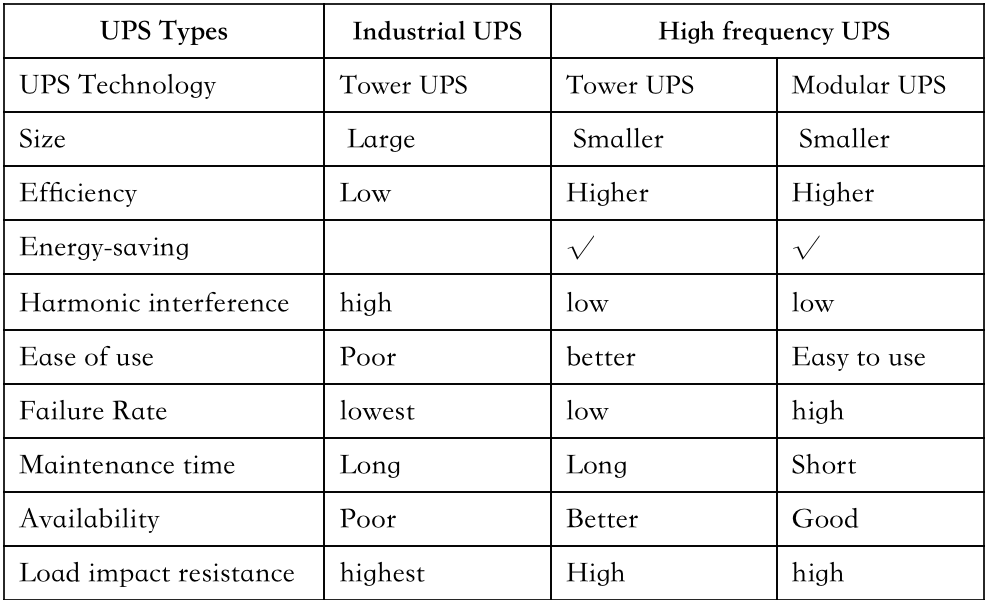
5:Frequently-asked questions of UPS and battery
Q: The battery voltage is low, but the battery voltage is still not charged after more than ten hours of charging.
A:Judging from the phenomenon that the battery or charging circuit is faulty, you can check according to the following steps:
①Check whether the input and output voltage of the charging circuit is normal
② if the input of the charging circuits is normal and the output is faulty, pls disconnect the battery and test again,. If it is still abnormal, the charging circuit is faulty;
③if the output is normal after turning off the battery,It means that the battery has been damaged due to long-term uncharged, over-discharged, or has reached its lifespan.
Q: The UPS output is normal when there is mains power, but when there is an outage, the buzzer beeps for a long time.
A:Judging from the phenomenon that the battery or the inverter may be faulty, you can check according to the following steps:
①Check the battery voltage to see if the battery is undercharged. If the battery is undercharged, check whether the battery itself is faulty or the charging circuit is faulty.
②If the working voltage of the battery is normal, check whether the drive circuit of the inverter works normally. If the output of the drive circuit is normal, it means the inverter is damaged.
Q: When I turned on the UPS, there is no display on the panel, and the UPS does not work.
A: 1) Check whether the mains input fuse is burnt;
2) If the mains input fuse is in good condition, check whether the battery fuse is burnt because some UPS will turn off all the output and display of the UPS when the battery voltage cannot be checked by itself;
3) If the battery insurance is in good condition, check whether the main detection circuit works normally. If the mains detection circuit does not work properly and the UPS does not have the function of starting without mains, the UPS will also turn off all outputs and displays. ——If the city detection circuit works normally, then check whether the battery voltage detection circuit is normal.
6:Benefits of precision air conditioners for data centers
The common rule states that for every 10 degrees Celsius, the lifespan of components gets halved, that’s why data centers, telecom or server room require 24 hours of air conditioning per day, 365 days a year without interruption.
Unlike comfort air conditioners, which are designed to cool people, precision air conditioners are designed to cool sensitive IT equipment. The main function of the precision air conditioner is to control the temperature and humidity of the IT room. Because in addition to temperature, excessive humidity can also affect the normal operation of the device. So what are the advantages or benefits of precision air conditioners compared to comfort air conditioners?
Benefits of installing a Precision Air Conditioning System
- Can be operated continuously 24 x 7 for 365 days
- Ensure accurate temperature control in ± 34ºF
- Precise humidity control in ± 5%
- Demonstrate better air distribution
- Moves more air volume at higher speeds than standard Air Conditioner’s.
- Effective cooling for the proximal & remote device
Due to the aforementioned advantages shared by precision air conditioners, they have been widely used to cool high-density heat loads. For small IT rooms today, people use rack-type or small precision cooling to ensure IT equipment performs at optimal levels. While in the medium and large data center, several units of precision air conditioners (in-row type or room type) can coordinate with each other to provide effective cooling.
7.Off-Grid Inverters vs. Grid-Tied Inverters, How to Choose ?
Off-grid inverters rely on solar power and operate independently, allowing you to be completely disconnected from your grid supplier. They are ideal for remote locations with limited or no access to the grid and for those who want to ensure energy security. Sin embargo, they require battery storage and can be more expensive upfront.
In contrast, grid-tied inverters are connected to the utility grid, allowing you to export excess energy and receive credits. They are generally cheaper and easier to install but depend on the grid for power. The choice depends on your energy needs and circumstances.
8.What’s the Benefits of Modular UPS
An important advantage of the modular design is fast replacement and the hot swappable nature of modules.The removal or adding of modules can be carried out with the system running. You can replace the failure module as soon as possible without an expert.
Buyers of industrial uninterruptible power supply (Unión Postal Universal) are increasingly adopting modular UPS topology, primarily because of reduced mean-time-to-repair (MTTR) relative to monolithic UPS systems, specifically in remote locations.
On-premises data center operators are seeing the benefits of modular UPS topology: internal system redundancy, a smaller physical footprint, and scalability.
With parallel redundancy (N+X), all UPSs equally share the load to meet the total load demand. If one of the UPS fails, the remaining UPS can continue to support the load,which enhance the reliablity of the system.
Small Footprint:19 inch size power module and smaller batteries save the floor space and making the installation easier.
Parallel expansion: If your power requirements increase, you can add additional modules to your UPS without finding extra floor space or buying a new UPS.